Switched ON for zero emissions: designing for a rulebook that keeps moving
An owner ordering a vessel today is buying into a rulebook that refuses to sit still. The IMO’s Net-Zero Framework was agreed in principle in 2025, stalled at adoption, and only returns to the table at the end of 2026. The EU’s Emissions Trading System reached full coverage of shipping in January 2026, FuelEU Maritime tightens its carbon-intensity limits year on year, and national authorities and charterers keep adding conditions of their own. None of it points cleanly in the same direction, and a ship ordered now will spend three decades trading under rules that are still being written.
The instinct to wait it out is understandable, but for many shipowners it is the wrong call: the fragmentation will not resolve into one tidy global standard. The more durable response is to design for the uncertainty, ordering vessels that stay compliant across a range of outcomes rather than betting the specification on a single one. In our ‘ON Decarbonisation’ campaign’s shorthand, design once and comply everywhere. In practice that means lower energy demand, fuel flexibility and verified data built in from the keel up, so the asset is protected against both tightening rules and the stranded-asset risk that follows a wrong guess.
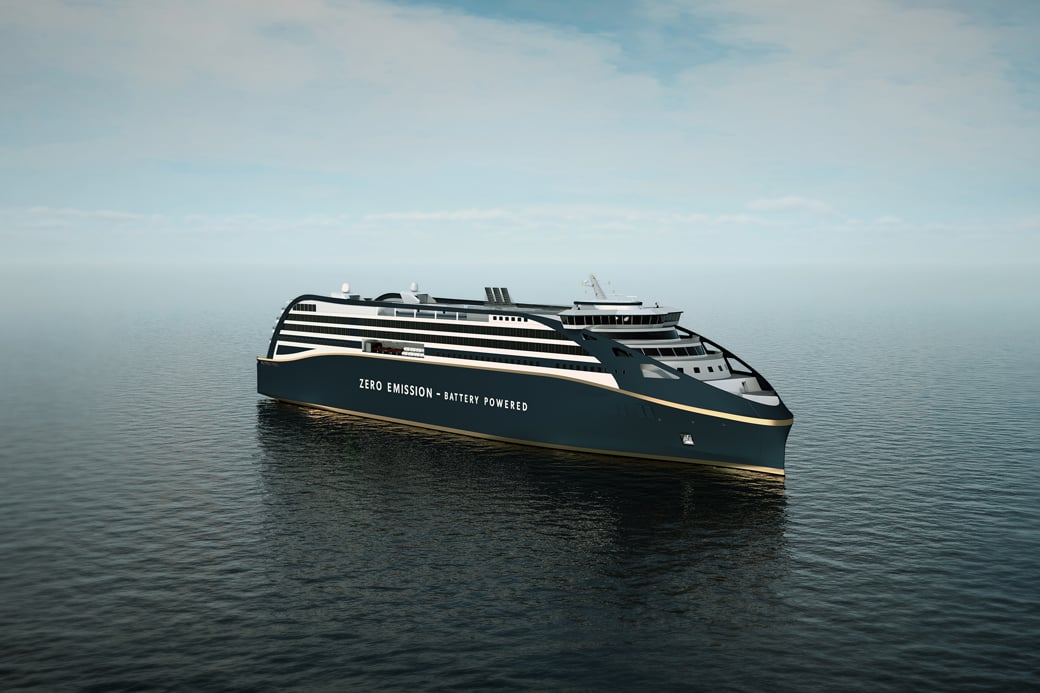
The obvious objection is that the cleanest, most future-proof designs cost too much. Our own engineers set out to test that. We modelled the total cost of ownership of two fully electric RoPax designs, one cargo-focused and one passenger-focused, against diesel equivalents across a spread of European ferry routes between 2030 and 2040. The electric designs came out with lower whole-life costs than diesel, by between eight and fifteen per cent, despite the higher price up front, and they held that advantage on busy short-sea corridors such as Tallinn to Helsinki and Dover to Calais. A design that would have looked like the risky, expensive choice two years ago is now the more resilient and flexible one.
The two concepts are deliberately different in emphasis. The cargo-focused design is built around schedule and throughput at slower service speeds, with propulsion delivered through two electric pods and battery capacity in the region of 35 to 56 megawatt-hours, expandable through modular compartments along the hull. The passenger-focused concept targets service speeds of up to 20 knots, pairing a centre shaft line and controllable-pitch propeller with two pods, battery capacity of up to around 100 megawatt-hours, heat-pump systems and intelligent energy management.
Oskar Levander, VP Strategy & Business Development at Kongsberg Maritime, who led the work, puts it like this:
“We are at a tipping point. What looked futuristic five years ago is commercially viable today on the right routes. The vessel is no longer the hard part. The real challenge now is charging infrastructure and the coordination around it: high-power connections aren’t available everywhere, and ports, grid operators and owners have to move together. This is a systems challenge as much as a ship-design one.”
Most vessels have no clean electrification pathway, and for them the same principle takes a different form. Resilience comes from building in adaptability now: efficiency that lowers energy demand whatever fuel is burned, arrangements that can take alternative fuels or wind assistance later without a structural rebuild, and systems that can be extended as the rules change. The aim is to keep a ship’s options open rather than lock it to one reading of a rulebook still in draft.
Which is why standing still is the exposed position. Ordering conventional tonnage and hoping the rules soften is a bet that carbon limits will loosen and that a vessel built for today’s assumptions will not be caught out, and neither looks likely. The owners who design for a moving rulebook now will be the ones still comfortably compliant, and still trading, when it finally settles.
Got questions?
To see the full RoPax study, or to discuss what a future-proof specification looks like for your fleet, get in touch with our team.

Explore ON Decarbonisation
Discover expert insights, industry discussions and practical pathways to maritime decarbonisation.