Evolving maritime training through retrofit and partnership
At the National Maritime College of Ireland (NMCI), Ireland’s national centre of excellence in maritime education and training, simulation is not an add-on — it is central to how future maritime professionals are prepared for life at sea.
NMCI is home to Ireland’s National Maritime Simulation Centre, a strategically important national capability supporting maritime education, training, and sectoral development. Located in Cork, the college plays a critical role in developing the skills required across Ireland’s maritime, offshore and shipping sectors.
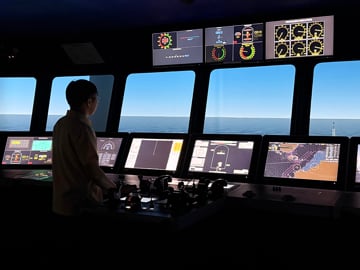
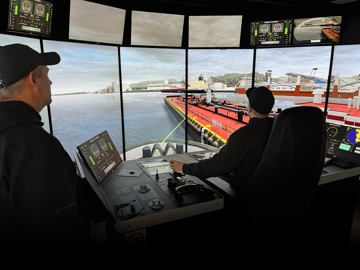
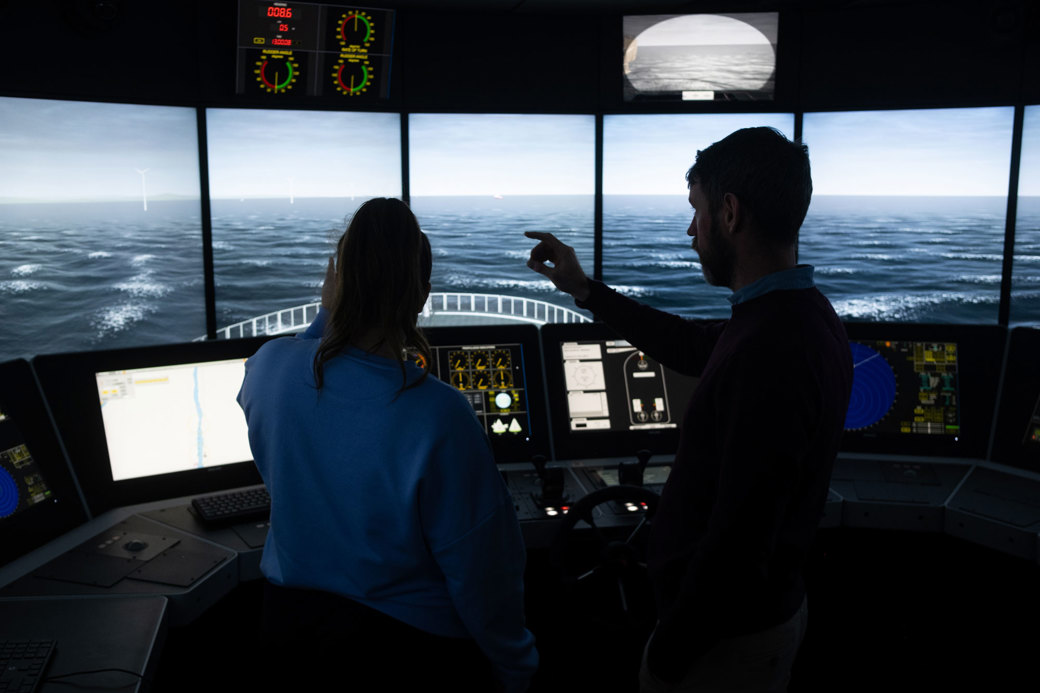
Its facilities include full-mission bridge simulators, engine room simulators, and integrated training systems designed to reflect real onboard operations.
For more than a decade, this environment has been shaped in close collaboration with Kongsberg Maritime — a partnership built on a shared ambition: to deliver training that keeps pace with an increasingly complex maritime industry. As the industry evolves, so too must the way seafarers are trained.
A training environment that evolves with the industry
The maritime sector is undergoing rapid transformation. From digitalisation and automation to stricter safety requirements and the energy transition, expectations for crew competence are higher than ever.
For NMCI, maintaining relevance means ensuring that its simulator infrastructure continues to evolve in line with these changes.
Kongsberg Maritime’s K-Sim technology has long provided the backbone of this training, enabling realistic, high-fidelity simulation across navigation, engine operations, and integrated team exercises.
By connecting bridge and engine room simulators into shared scenarios, students train as complete crews — developing not only technical competence, but also communication, situational awareness, and decision-making under pressure.
A strategic decision: upgrading through retrofit
In 2025, NMCI took a significant step forward by completing a comprehensive upgrade of its simulator facilities in collaboration with Kongsberg Maritime. This investment was supported by the Department of Further and Higher Education, Research, Innovation and Science, and the Department of Defence, whose funding has enabled the development of this national maritime simulation capability.
Rather than replacing the entire infrastructure, NMCI adopted a full retrofit approach — modernising key systems while building on its existing simulation environment.
The upgrade combined extensive hardware renewal across both bridge and engine room simulators, alongside updated software and system architecture. This approach enabled NMCI to significantly enhance its training capability while preserving continuity and protecting previous investment.
Enhancing realism — and learning outcomes
For students and instructors, the impact of the upgrade is immediate. Modern simulation is no longer just about replicating equipment — it is about recreating the complexity of real-world operations.
With the upgraded simulation environment, NMCI can now deliver more advanced and varied training scenarios, greater environmental realism, and fully integrated bridge and engine room exercises.
The modernised hardware ensures improved responsiveness and reliability, while the updated K-Sim systems enable seamless interaction between training domains. Together, this creates a more immersive and effective learning environment.
This enables students to experience scenarios that would be too costly, risky or impractical to recreate at sea — from emergency response situations to complex operational planning.
A partnership built on trust and continuity
While technology plays a critical role, the long-term partnership between NMCI and Kongsberg Maritime remains central to the project’s success.
What has made this partnership work over time is the ability to evolve together. Our training requirements have changed alongside the industry, and Kongsberg Maritime has continuously supported that development — not just by delivering technology, but by helping us adapt, upgrade and improve our simulator environment. The retrofit project is a strong example of this. Instead of starting from scratch, we were able to build on our existing capabilities, modernise our systems, and ensure that our training remains aligned with current vessel operations. That continuity is extremely valuable to us.
This long-term approach reflects a broader philosophy seen across leading maritime training institutions: future-ready training depends not only on advanced simulation, but on sustained collaboration that keeps systems reliable, up to date and fit for purpose.
For NMCI, it provides confidence that both technology and partnership will continue to evolve in step with industry needs.
Preparing for the future of maritime training
As the maritime industry continues to evolve, the role of simulation will only become more central.
From autonomous vessels to decarbonisation and increasingly complex onboard systems, tomorrow’s seafarers will require a broader and more advanced skillset.
At NMCI, this is supported by advanced technology, experienced instructors, and strong industry partnerships — ensuring that graduates are prepared not only for today’s maritime sector, but for its future.
Through this approach, NMCI continues to play a leading role in shaping maritime education and training, supporting Ireland’s position as a globally recognised maritime nation.