Power systems
K-Power Portfolio
Power system product families
The following product families form the building blocks of Kongsberg Maritime power systems. They are combined, configured, and validated at system level to deliver predictable behaviour across operating modes, peak loads, and failure scenarios.


Products engineered as part of a system
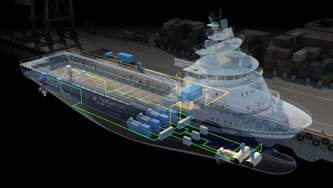
Power system performance is not created by individual products. It emerges from how generation, storage, conversion, distribution, and control work together under real operating conditions. Our power system products are:
 |
 |
 |
 |
| Engineered to operate together within integrated power and propulsion plants | Validated through system‑level modelling and operational simulation | Configured based on operational profiles, not vessel categories | Supported throughout the vessel lifecycle as part of a long‑term partnership |
This approach enables bespoke power systems - designed vessel by vessel, operation by operation.

K‑Power Control
System intelligence that shapes power behaviour in real time
K‑Power Control coordinates power production, distribution, and energy optimisation across the vessel - ensuring stable, efficient, and resilient power system behaviour across all operating modes.
Enables:
- Real‑time power allocation
- Stable operation under dynamic and failure conditions as part of a long‑term partnership
Frequently asked questions
They are engineered to operate as part of a coherent system, validated through system‑level simulation, and configured based on operational profiles rather than vessel categories.
K‑Power Electrical Systems define how power systems are configured across AC, DC, and hybrid architectures based on operational requirements, redundancy needs, and long‑term energy strategy.
No. Electrical Systems provide a flexible structural framework. The final configuration is always determined by system‑level analysis and simulation.
K‑Power Control is the integrated power and energy control solution that coordinates generation, distribution, and optimisation to ensure stable and efficient power system behaviour in real time.
Traditional PMS focuses on equipment control. K‑Power Control embeds system‑level intelligence that governs behaviour across operating modes, failures, and dynamic load conditions.
Power systems typically include electric drives, switchgear and starters, energy storage, power distribution and conversion equipment, and electrical machines — all configured and validated together.
Yes. Product selection and configuration are driven by mission profile, duty cycles, redundancy philosophy, and lifecycle requirements — not standard templates.
Electrical Sub-Systems do not define the core power system architecture. Instead, it builds on the vessel’s main power system, enabling the integration of additional electrical sub-systems and lifecycle services that enhance performance, flexibility, and operational efficiency.
Products are supported through global lifecycle services, including service, optimisation, upgrades, and retrofit pathways to ensure long‑term performance and compliance.