
Oskar Levander, Kongsberg Maritime’s Vice President Strategy and Business DevelopmentCompliance with ETS and CII not only ensures environmental responsibility but can also position ship owners competitively in a market where there is a growing focus on sustainable operations. Understanding and adapting to these regulations is essential for maintaining operational efficiency and long-term viability for ship owners.
Latest maritime regulations: shaping future energy choices
The FuelEU Maritime Regulation, effective from January 1, 2025, marks a significant step in the European Union’s efforts to decarbonise the maritime sector. FuelEU aims to reduce greenhouse gas (GHG) emissions from marine fuels, driving the transition to low-carbon and renewable energy sources.
Under the FuelEU Maritime Regulation, all commercial ships above 5,000 gross tonnage – the same threshold as ETS – calling at EU ports must reduce the GHG intensity of the energy used by 2 per cent compared to the baseline – an average intensity of the fleet in 2020.
These reduction targets will increase every five years, aiming for an 80 per cent reduction by 2050. Compliance involves collecting and reporting data on fuel usage and adopting Onshore Power Supply (OPS) technology at major EU ports by 2030.
In April 2025, the International Maritime Organization (IMO) also approved new net-zero regulations aimed at drastically reducing GHG emissions from the global shipping industry. These regulations, set to be formally adopted in October 2025 and enforced by 2027, represent a significant step towards achieving net-zero emissions by 2050. The IMO Net-Zero Framework introduces mandatory emissions limits and a global pricing mechanism for GHG emissions, making it the first of its kind to encompass an entire industry sector. Key elements include a new fuel standard for ships and a global economic measure, requiring ships to reduce their annual greenhouse gas fuel intensity (GFI) over time.
Oskar Levander adds: “The new IMO regulations set a clear cost on using fossil fuels and will be an essential driver for achieving the IMO GHG reduction targets. At Kongsberg Maritime, we are committed to supporting our customers in navigating these changes and adopting innovative technologies that meet these stringent standards.”
These measures will also apply to large ocean-going ships over 5,000 gross tonnage, which account for 85 per cent of total CO2 emissions from international shipping. The framework aims to accelerate the introduction of zero and
near-zero GHG fuels, technologies and energy sources.
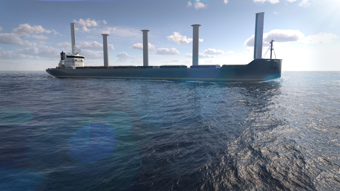
Oskar continues: “While not a supplier of engines, Kongsberg Maritime can play a pivotal role in helping ship owners navigate these new regulations through the provision of integrated systems and alternative energy sources like batteries and wind-assisted propulsion. As a technology integrator, we offer consultancy services to guide owners in making informed decisions about energy choices and investments.”